Octopus Energy
Assessed 16 July 2026 under NZ · Medium confidence
Evidence last captured 28 August 2026 · oldest 16 July 2026 · next re-check due 16 July 2027
The company has responded to this assessment.
A grade rules on whether a public claim is substantiated. It is not a finding about environmental performance, truthfulness, or the merit of the business. HowLegit is not a licensed adviser and nothing here is legal or investment advice.
Where this sits
All 21 energy companies, assessed against the same checklist in the same window.
Octopus Energy ranks 1 of 21 in this sector by overall score, between 47.6% and 96.0%.
Findings
No environmental certifications (Toitu, carboNZero, ISO 14001) or sustainability reporting for NZ operations. Parent's 300 global renewable projects positioned without clarifying they don't supply NZ electricity.
Why this matters. Without NZ-specific environmental credentials, the company's environmental positioning rests entirely on the UK parent's global portfolio, assets that have no connection to New Zealand's electricity grid.
What closing this looks like
- Publish a corporate carbon footprint for NZ operations (Scope 1+2) given the NZ entity's limited physical operations make this proportionate and straightforward
- Add a clarifying statement on the about page noting that Octopus Energy NZ is a pure retailer and does not own generation assets; the global group's renewable projects do not supply NZ customers' electricity
“Group renewable investment presented on New Zealand surfaces”
The help page states that Octopus Energy Group invests in renewable energy projects internationally as part of a commitment to moving to cleaner energy. The group portfolio is real and is accurately attributed to the group. What is absent is any environmental disclosure for the New Zealand business itself: no carbon footprint, no environmental certification and no sustainability reporting appear in the published sitemap of 17 URLs, the primary and footer navigation, or any of the 50 blog posts, checked 14 August 2026.
Captured 14 August 2026 · source page ↗

“300 renewable energy projects across 8 countries (Octopus Energy Generation)”
Verifiable parent entity claim. 300+ renewable energy projects across 8 countries is a documented Octopus Energy Generation statistic. Presented on the about page as a group credential, not as an NZ-specific claim.
Captured 14 August 2026 · source page ↗

“Octopus Centre for Net Zero research centre”
Verifiable parent entity institution. The Centre for Net Zero is a real UK-based research centre. Presented as a group credential on the about page, accurately attributed to the global group.
Captured 14 August 2026 · source page ↗

Environmental positioning rests on demand-side activity that is published and measured: time of use pricing, Saving Sessions, Hot Water Control and solar export volumes.
Why this matters. Multiple environmental positioning claims across social media bios and about page but no NZ-specific environmental data. As a pure retailer, Octopus does not generate electricity and procures from the same NZ wholesale market as all retailers. Environmental positioning creates an impression of differentiation that does not exist.
What closing this looks like
- Add a clarifying statement on the about page noting that Octopus Energy NZ is a pure retailer and does not own generation assets; the global group's renewable projects do not supply NZ customers' electricity
- Publish a corporate carbon footprint for NZ operations (Scope 1+2) given the NZ entity's limited physical operations make this proportionate and straightforward
- Replace "transition to a clean energy future" on social media bios with language grounded in specific NZ activities (e.g., "helping NZ households shift electricity use to cleaner, cheaper times")
- Publish an interim target or a baseline for the demand-side contribution already reported. Saving Sessions results, solar export volumes and hot water control are measured and published; what is missing is a figure the company commits to rather than reports after the fact.
“We make it easy for customers to access affordable power as we transition to a clean energy future”
The pathway is published. Every plan is time of use by design to move demand away from peak, Saving Sessions and Hot Water Control are reported with measured results, around 40 percent of the customer base has solar, and network peak export rebates are passed through in full. For a retailer that owns no generation, demand-side activity is where a contribution to the energy transition can be made, and it is evidenced.
Captured 14 August 2026 · source page ↗

“Do Energy Better" (aspirational tagline with possible environmental connotation)”
Defined on the About Us page, which names Hot Water Control, Saving Sessions and the network peak export rebates and closes by stating what the company means by doing energy better. Graded once, under C1, and cross-coded here.
Captured 14 August 2026 · source page ↗

Technology-focused branding (purple/octopus) is not disproportionate to environmental engagement.
Why this matters. The brand identity does not over-promise on environmental credentials, reducing the risk of green-impression claims that cannot be substantiated.
Environmental messaging appears where relevant and is absent from commercial pages. Consistent but thin.
Why this matters. Environmental claims are not used to sell plans, which is appropriate for a retailer that does not own generation assets. The messaging is limited but honest about that position.
“Off-peak power reduces demand for carbon-intensive generation”
Technically accurate contextual claim. Off-peak electricity consumption correlates with lower demand for carbon-intensive peaking generation, consistent with NZ grid dynamics. Appropriately qualified.
Captured 14 August 2026 · source page ↗

“Solar buyback supports renewable energy transition”
Contextual claim with reasonable basis. Solar buyback inherently supports distributed renewable generation in NZ. Appropriately framed as a co-benefit of the commercial offering rather than an environmental commitment.
Captured 14 August 2026 · source page ↗

Alignment with New Zealand's 100% renewables by 2030 goal is supported by published demand-response and solar export results. No interim target or baseline of the company's own is published.
Why this matters. Aspirational environmental targets without interim milestones or measurable commitments cannot be tracked or verified. They create an impression of environmental leadership without accountability.
What closing this looks like
- Replace 'transition to a clean energy future' on social media bios with language grounded in specific NZ activities (e.g., 'helping NZ households shift electricity use to cleaner, cheaper times')
- Publish an interim target or a baseline for the demand-side contribution already reported. Saving Sessions results, solar export volumes and hot water control are measured and published; what is missing is a figure the company commits to rather than reports after the fact.
“Support NZ's goal of 100% renewables by 2030”
The contribution is published and measured. Nine Saving Sessions were run with 20 percent participation and an average 50 percent load reduction each session, reported as 244,000 kWh if scaled nationally and as avoiding an hour of peaker gas generation at times of grid stress. Solar customers exported 1.5 GWh in December, and around 40 percent of the customer base has solar. Hot water control shifts 3 to 4 kWh a day away from peak. What is not published is an interim target or a baseline of the company's own.
Captured 14 August 2026 · source page ↗

Social positioning on the About Us page is set alongside the mechanisms it rests on: flexible plans, off-peak and night rates, solar buyback, and published support for customers in difficulty.
Why this matters. Broad social positioning is easier for a customer to trust when the page shows what sits behind it. Here the wording and the mechanisms appear together, and the supporting pages carry the rates and the support options. The remaining gap is presentational: the service hours a customer would meet are not shown beside the word accessible.
What closing this looks like
- Add a "NZ operations" section to the about page distinguishing NZ-specific operations (headcount, customer base, service area) from global group statistics
- Set the accessibility claim alongside what is actually available. The About Us page describes the service as accessible while the published hours are weekday only. The 24/7 faults line, the app and the 35 second average answer time are not shown next to that word anywhere a customer would meet them together.
“Making energy affordable and accessible”
Substantiated. The positioning is stated as an aspiration and the page sets out how it is pursued in the next sentence: plans that cater to diverse energy needs, off-peak and half-price night rates, and solar buyback. Those mechanisms are published across the site, with off-peak rates on 36 surfaces and the buyback rate on 12. Support for customers in difficulty is published separately, including budget advisor referrals and registration for medically dependent customers. Whether the resulting prices are competitive is assessed at C1.
Captured 14 August 2026 · source page ↗

“100+ NZ employees, Wellington development centre”
Substantiated. The 2022 statement that Octopus Energy employs over 100 people across Aotearoa is now set out in detail on the About Us page: 16 running the New Zealand retail electricity business, around 100 in the Wellington office supporting UK customers, and approximately 20 in the Kraken team.
Captured 14 August 2026 · source page ↗

“MDC protection: "It's really important we have this information on file for your safety”
MDC support is substantiated. Dedicated consumer care policy (v1.1) and vulnerable customer support pages are published at /customer-care/ paths with comprehensive content meeting EA Consumer Care Obligations. Content includes MDC registration, financial hardship support (payment plans, budgeting service referrals), and medically dependent consumer protections.
Captured 14 August 2026 · source page ↗

“Part of global group: 7.2M+ customers, 50M+ accounts on Kraken”
Verifiable absolute claim. 7.2M+ customers and 50M+ Kraken accounts are documented group statistics consistent with independent reporting. Appropriately framed as group-level on the about page.
Captured 14 August 2026 · source page ↗

“Major investors include Generation (Al Gore's firm), CPPIB”
Verifiable. Generation Investment Management and CPP Investments are documented shareholders. Ownership structure is publicly available and accurately presented on the about page.
Captured 14 August 2026 · source page ↗

Consumer care policy and vulnerable customer support pages are published with substantive content including hardship provisions, budgeting service referrals, and EA Consumer Care Obligation compliance.
Why this matters. Policy and risk disclosure is accessible to consumers at the point of need. Financial hardship support pathways are clearly documented with specific referral partners and resolution timeframes.
“Financial hardship support: payment plans, referrals to support organisations”
Help page provides specific hardship support references including payment plans, Citizens Advice Bureau, NZ Federation of Family Budgeting Services, Salvation Army, and Work and Income NZ. Functional and appropriate.
Captured 14 August 2026 · source page ↗

Clear complaints process with defined timeframes and external escalation to Utilities Disputes.
Why this matters. Complaints page provides clear process: email, phone, 2 business day initial response, 20 business day resolution target. External escalation to Utilities Disputes documented. Financial hardship support references provided.
“Respond to help inquiries within 2 business days”
Stated in both the complaints page and T&Cs. A specific, verifiable operational commitment with a clear timeframe.
Captured 14 August 2026 · source page ↗

“Complaints resolution within 20 business days”
Stated on the complaints page with clear process and 20 business day resolution target. External escalation to Utilities Disputes (free, independent) also documented.
Captured 14 August 2026 · source page ↗

“24/7 faults service”
Verified on the contact page and in T&Cs. Faults are managed by network companies but Octopus provides a 24/7 contact pathway. Operational commitment that is verifiable.
Captured 14 August 2026 · source page ↗

UK TrustPilot ratings are cited on the About Us page with an explicit statement that they exclude New Zealand electricity customers.
Why this matters. A 5-star Trustpilot rating based on 800,000+ global reviews does not reflect New Zealand customer experience. With only ~7,000 NZ customers, the global rating does not represent local service quality.
What closing this looks like
- Create NZ-specific review collection mechanism (Google Business Profile or on-site reviews) to separate NZ service quality signal from the global Trustpilot rating that does not reflect NZ operations
“UK TrustPilot ratings cited on the New Zealand About Us page”
The rating is attributed to Octopus Energy UK and the same sentence states that those ratings do not include New Zealand electricity customers. The qualification sits with the claim rather than apart from it, so a reader cannot mistake a group service rating for a local one.
Captured 14 August 2026 · source page ↗

Positioning claims are now defined on the About Us page, which names the activities behind them and publishes a service measure.
Why this matters. Consumers and stakeholders assessing social responsibility have no data to evaluate. For a company operating in New Zealand, the absence of any community engagement programme is a notable gap.
What closing this looks like
- Add a 'NZ operations' section to the about page distinguishing NZ-specific operations (headcount, customer base, service area) from global group statistics
- Set the accessibility claim alongside what is actually available. The About Us page describes the service as accessible while the published hours are weekday only. The 24/7 faults line, the app and the 35 second average answer time are not shown next to that word anywhere a customer would meet them together.
“Passionate energy specialists”
Energy Specialists is the role name for the customer team, not a claim of certification. The About Us page describes the operating model behind it, where one person owns a problem through to the lines company, the meter provider and support agencies, and publishes a service measure of 35 seconds average time to answer as at July 2026.
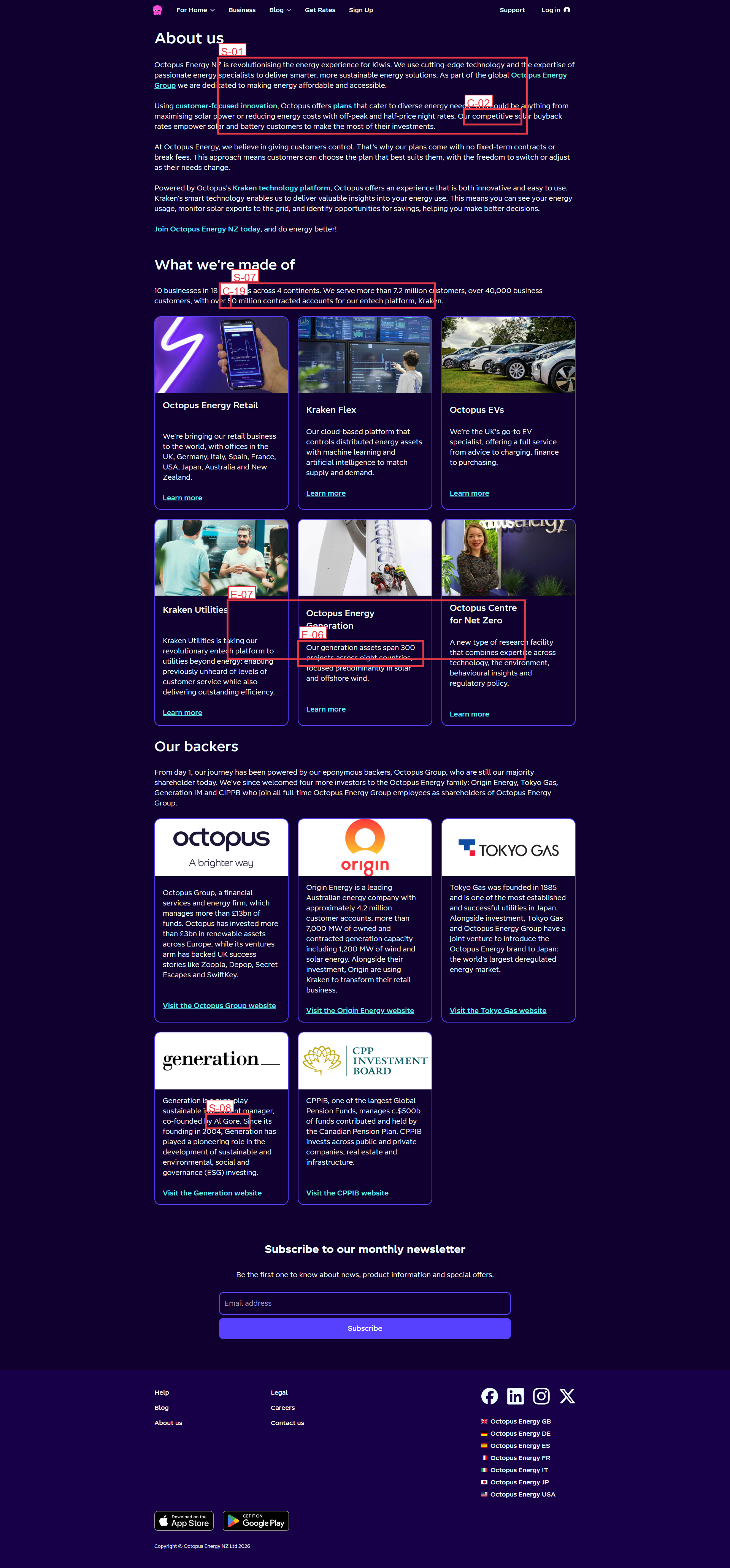
“Revolutionising the energy experience for Kiwis”
Substantiated by named activity rather than by assertion. The About Us page lists Hot Water Control, Saving Sessions and full pass-through of network peak export rebates, and states that some have since been adopted by other retailers. Graded once, under C1, and cross-coded here.
Pricing claims are substantiated or carry a route to substantiation. Night rates, hot water control savings, Saving Sessions rates and off-peak hours are each verifiable from published material. "Competitive pricing" now carries a comparison callout on the pages that make the claim, linking to Billy and Powerswitch.
Why this matters. A consumer comparing retailers needs a route to the evidence behind a pricing claim. That route now sits on the pages that carry the claim, and it points to two independent New Zealand comparison services.
“Do Energy Better”
Defined on the About Us page, which names Hot Water Control, Saving Sessions and the network peak export rebates and closes by stating what the company means by doing energy better.
Captured 14 August 2026 · source page ↗

“Revolutionising the energy experience for Kiwis”
Substantiated by named activity rather than by assertion. The About Us page lists Hot Water Control, Saving Sessions and full pass-through of network peak export rebates, and states that some have since been adopted by other retailers, which is a claim a reader can test.
Captured 14 August 2026 · source page ↗

“Smart, flexible energy plans designed to help you save money”
The descriptors attach to named features. Time of use pricing, Hot Water Control and Saving Sessions are each published with their own terms, and the plans page sets out what flexibility means in practice: no fixed-term contracts and no break fees.
Captured 14 August 2026 · source page ↗

“16 hours of cheaper off-peak energy daily" (business)”
Verifiable from published business plan rate structure. 16 hours of off-peak pricing is a documented feature of the business energy plans.
Captured 14 August 2026 · source page ↗

“Competitive pricing”
The comparison route now sits on the page that makes the claim. "Competitive pricing" carries an asterisk on the homepage, the plans page and the solar and battery page, and a callout directly beneath the plan tiles reads "Compare prices at the independent comparison sites Billy or Powerswitch", with both names linked. Billy is built and run by the Electricity Authority, the Crown entity that regulates the electricity industry, and Powerswitch is run by Consumer NZ. Section 12A of the Fair Trading Act turns on whether there were reasonable grounds when the representation was made; the company's stated grounds are its position on those two services, and a reader is now pointed to both from the page carrying the claim rather than from the contact and complaints pages. Billy publishes an open directory of every New Zealand retailer, including a page for Octopus setting out its plans, service hours, billing options and support provisions. The price comparison itself is one the reader runs, by uploading a bill or answering Billy's survey, because rates vary by network region and plan. Verified live on 28 August 2026.
Captured 28 August 2026 · source page ↗

“Night rates "half the price of Peak rates”
Verifiable from published rate cards. Night rates are approximately half of peak rates across plan types, consistent with the claim. Blog post provides detailed breakdown.
Captured 14 August 2026 · source page ↗

“Up to $150/year savings with hot water control”
Stated with 'up to' qualifier on the hot water control page. Savings estimate is qualified and the product description is transparent about adjustable levels.
Captured 14 August 2026 · source page ↗

“$2 for every kWh of electricity you reduce" (Saving Sessions)”
Documented on the Saving Sessions page with transparent calculation methodology (10-day baseline comparison). Specific, verifiable pricing commitment.
Captured 14 August 2026 · source page ↗

“Up to 70 cents per kWh" for battery discharge (Queenstown)”
Stated in blog post about Aurora network Q&A. Specific to Queenstown network conditions with 'up to' qualifier. Appropriately contextualised.
Captured 14 August 2026 · source page ↗

Pricing requires an address lookup before any rate is shown. Zero Bills terms are set out in full on the product page.
Why this matters. When consumers cannot see indicative pricing before entering their address, they cannot comparison-shop effectively. The undisclosed daily charge increases mean pricing has changed materially without prominent disclosure.
What closing this looks like
- Publish indicative pricing ranges for major network regions on the plans page, enabling consumers to assess competitiveness before entering the signup funnel
- Move the Fair Usage Allowance line directly beneath the Zero Bills headline it qualifies. It currently sits below a full width illustration and a section heading, at half the type size.
“Solar buyback rates: 19c peak / 14c off-peak (OctopusFlexi)”
Published rates on the solar & battery page. 19c peak / 14c off-peak for OctopusFlexi are specific, verifiable pricing disclosures.
Captured 14 August 2026 · source page ↗

“Zero Bills: "we guarantee you pay nothing for your electricity usage* for five years"”
Substantiated on the Zero Bills page. The guarantee is stated as five years, the asterisk resolves on the same screen to a personalised Fair Usage Allowance set at or above historical usage, and ten questions and answers cover the term, the tariff charged above the allowance, hardware failure, exports and the fact that the homeowner covers the cost of the solar and battery system.
Captured 14 August 2026 · source page ↗

The superiority claim has been withdrawn. "Leading" no longer appears on the plans, homepage, solar and battery or OctopusPeaker pages, and the buyback claim now reads "competitive" with a callout linking to the Powerswitch solar rates table.
Why this matters. Solar customers choose a retailer on buyback rates. The claim now points to an independent table that publishes every retailer's rate, so the comparison is available to the reader rather than taken on faith.
“Competitive solar buyback rates”
"Leading" has been removed. As at 28 August 2026 it no longer appears as a comparative about Octopus on the homepage, the plans page, the solar and battery page or the OctopusPeaker page. What remains is "competitive", marked with an asterisk, with a callout directly beneath the feature tiles on the OctopusPeaker page reading "Compare buy-back rates at the independent comparison site Powerswitch" and linking to the Powerswitch solar rates table. That table, published by Consumer NZ and updated June 2026, lists thirteen retailers and puts Octopus first: 19 cents per kWh at peak on OctopusFlexi and 23 cents at peak on OctopusPeaker, against 15 cents at Meridian, 13 at Powershop, 12 at Genesis and Pulse, 11.1 at Mercury, 10 at Nova and 8 at Contact. The comparative is supported by the independent source the page itself links to. The word survives on three dated posts from 2022 to 2024, which are point-in-time pieces rather than live claims.
Captured 28 August 2026 · source page ↗

Clean design with no high-pressure sales tactics or artificial urgency.
Why this matters. Consumers can evaluate plans without time pressure or manipulative framing, supporting informed decision-making.
“PowerShare: "treat sites as one connected energy ecosystem”
Contextual claim describing a specific business product feature. PowerShare aggregates multiple business sites under one account. Product description is clear and not misleading.
Captured 14 August 2026 · source page ↗

“$100 referral credit (business)”
Specific, verifiable referral offer. $100 credit for business referrals is a clear, quantified commercial offer.
Captured 14 August 2026 · source page ↗

'No fixed-term contracts or break fees' substantiated by March 2026 T&Cs. Fee schedule comprehensive.
Why this matters. Consumers can switch providers freely without financial penalty. The comprehensive, GST-inclusive fee schedule means no hidden costs at exit.
“No fixed-term contracts or break fees”
Verified in T&Cs effective March 5, 2026. No fixed-term contract; customer may terminate anytime by notifying the company. No early termination fee in the schedule of fees.
Captured 14 August 2026 · source page ↗

Complaints process clear with timeframes. External escalation to Utilities Disputes documented.
Why this matters. When something goes wrong, consumers have a clear path from complaint to independent resolution, with stated timeframes at each step.
“Complaints resolution within 20 business days”
Stated on complaints page with clear process. External escalation to Utilities Disputes documented. Consistent with T&Cs.
Captured 14 August 2026 · source page ↗

“24/7 faults service”
Verified on contact page and T&Cs. Consistent 24/7 faults service commitment across platforms.
Captured 14 August 2026 · source page ↗

“Intelligent Octopus" beta ("not always going to be perfect")”
Honest beta disclosure. 'It's not always going to be perfect' is a transparent consumer expectation-setting statement. Appropriately manages expectations for a new technology product.
Captured 14 August 2026 · source page ↗

“Response within 2 business days”
Stated in complaints page and T&Cs. Specific, verifiable operational commitment with clear timeframe.
Captured 14 August 2026 · source page ↗

Ownership structure transparent. Clearly identifies as part of global Octopus Energy Group with major investors listed.
Why this matters. Transparency about corporate ownership and investor backing lets consumers and regulators assess who stands behind the brand.
“Kraken platform: 50M+ accounts globally”
Verifiable absolute claim. 50M+ accounts on Kraken is documented in investor reporting and media coverage. Appropriately presented as a global group statistic.
Captured 14 August 2026 · source page ↗

No environmental comparative claims identified.
Why this matters. No environmental comparative claims identified. The solar buyback comparative is primarily commercial and is assessed under C3.
Basic cultural awareness observed in NZ communications ('Kia ora' in contact email). No cultural integrity concerns or misrepresentation risks identified from available evidence.
Why this matters. The limited cultural engagement observed is proportionate to Octopus Energy's positioning as a technology-focused market entrant. No misrepresentation risks were identified.
What has changed since first assessment
Assessed from the public record. Octopus Energy is the one retailer in this scan that engaged with its right of reply: it reviewed the findings, pointed us to evidence already published on pages our crawl had not reached, and amended others, and we reassessed each time it did. One further change was ours, made on our own initiative. What moved, and why.
- 15 July 2026First assessmentFirst assessmentB-
Assessed from the public record, unsolicited, as part of the New Zealand energy sector scan. Octopus did not commission it.
RL-001
- 9 August 2026First regradeAfter the company respondedB
The finding that remained was the URL architecture itself: a stale sitemap with no redirects.
RL-001
- 14 August 2026Second regradeAfter the company respondedA-
Octopus submitted ten items across eight checkpoints - E1, E6, S1, S5, S6, C1, C2 and C3 - pointing to evidence already published on surfaces our crawl had not reached. Twelve claims moved from FLAG to PASS on that evidence, and the overall score moved from 67.4 to 86.3.
2026-08-14_octopus_regrade2_session-state.md
- 15 August 2026CorrectionOur correctionA
This one was ours, not something Octopus submitted. The flag on "Making energy affordable and accessible" rested on three grounds and none of them held on a second look: one was answered by the company's own published rates, and two asked for standards the claim never invoked. We withdrew it.
apply_s1_1_ruling.py, 2026-08-15
- 28 August 2026Third regradeAfter the company respondedA
Octopus returned on two commercial checkpoints, C1 and C3, with amended pages answering the conditions we had flagged. Both moved from FLAG to PASS, taking Commercial to 100.0 and the overall score from 90.3 to 96.0.
2026-08-28_octopus_regrade3_session-state.md
Cite this
One company, with every graded claim, its own published wording and the dated capture each grade rests on.
You are here
The full analysis behind these grades: what the sector claims, how much of it holds up, and the seven findings that run across it.
Read it, free and without registration →
HowLegit, Octopus Energy — messaging integrity assessment.
Energy sector register, assessed 16 July 2026.
Overall A (96.0%).
https://howlegit.com/register/Energy/octopus-energy

A grade rules on whether a public claim is substantiated, not on its
truth or on the merit of the business. Not legal or investment advice.
Produced by HowLegit, which also sells audits commercially. The data on
this page is public.
This entry is part of a complete sector scan. Companies not listed on the Energy register were not assessed — which is not the same as being cleared.